Reflections from the UK Cilia and Centrosome Network Meeting June 2025
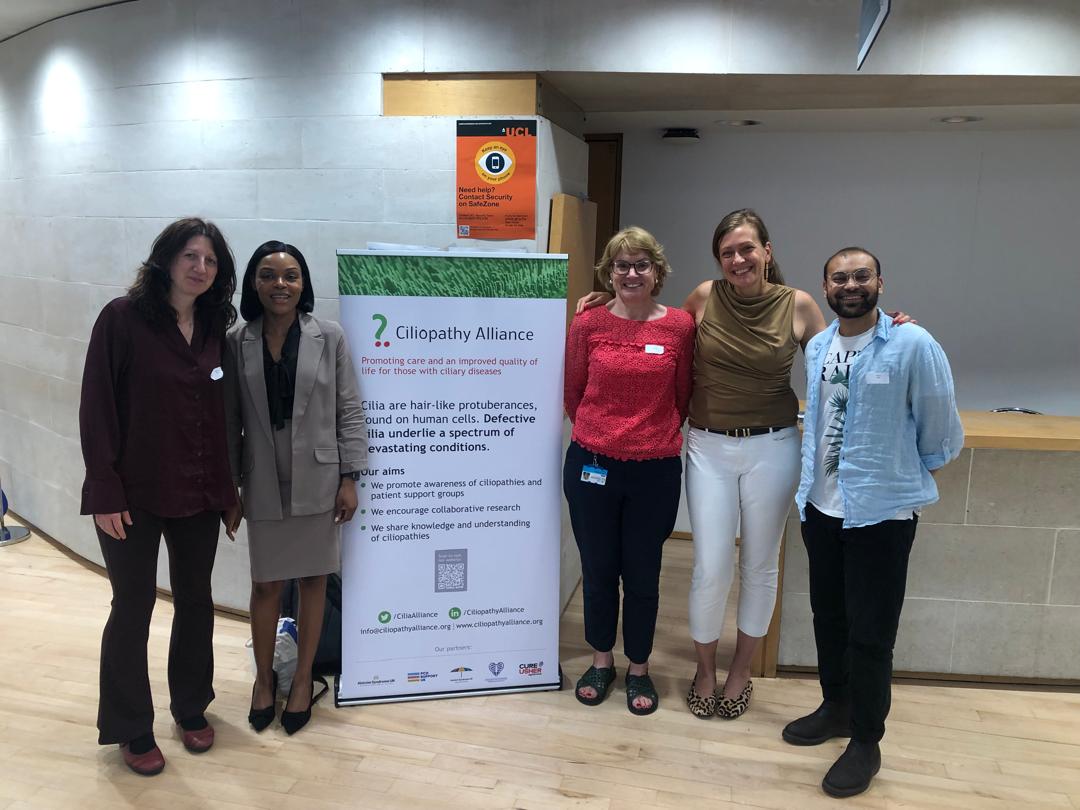
On Friday, 20th June 2025 - some of our Trustees attended the UK Cilia and Centrosome Network Meeting which was hosted by Hannah Mitchison our Chair. Thanks to Kerry Leeson-Beavers for updating the group about the CAUK's strategy.
It was Temi's first Cilia Scientific Meeting (as Treasurer of the Ciliopathy Alliance UK) - here are her reflections:-
Earlier this month, I had the opportunity to attend the UK Cilia & Centrosome Network Conference. As someone with a background in biochemistry and a professional focus on digital and AI transformation, I found the conference both intellectually stimulating and deeply affirming.
Surrounded by researchers working at the forefront of rare disease science, I was reminded how deeply collaborative and multidisciplinary this space is — blending biology, data, and clinical need. Despite advances in microscopy, molecular modelling, and signalling studies, one central challenge echoed across many presentations: how do we extract clarity and meaning from biological complexity?
What stood out to me was the way scientists communicated their work — with clarity, caution, and deep commitment. I learned how modelling cilia as elastic filaments reveals how subtle asymmetries govern their movement. How real-time imaging of kinesin motor proteins illuminates their role in vesicle trafficking and potential links to kidney homeostasis. How macrophages may influence cyst growth in Polycystic Kidney Disease. And how cytoskeletal proteins might contribute to tumour invasion.
It was particularly striking to hear that urine-derived cells could one day serve as patient-specific testing tools — and that the choreography of flagella involves not just motion, but mechanics, force, and architectural design.
At one point, a speaker asked whether artificial intelligence could eventually decode the choreography of cilia. It was a powerful question. While AI offers segmentation, speed, and prediction, the recurring theme throughout the conference was that meaning still needs human insight. That reminder stayed with me: that innovation, no matter how technical, is always human at its core.
I left the conference with several questions still echoing:
- Could we train AI to detect ciliopathies earlier — just from how cells move? Should we?
- How do we ensure rare disease breakthroughs don’t stall at the proof-of-concept stage?
- What does readiness look like when innovation moves faster than implementation?
I’m deeply grateful to the Ciliopathy Alliance for the opportunity to attend, and to all the researchers and clinicians who continue doing this critical work with such focus and humility.
By Temitope Oyefuga